The B2B Buyer’s Reverse Engineered Guide to Robot Vacuum Procurement
Executive Summary
For the B2B decision-maker, the robot vacuum market presents a paradox. Marketed as a simple plug-and-play solution, the reality involves a complex matrix of performance trade-offs, hidden costs, and strategic positioning choices. The value Super high opportunity lies not in accepting the consumer-grade narrative but in reverse-engineering the procurement process from operational outcomes. This analysis deconstructs the sector through a B2B lens, moving beyond brand marketing to evaluate robotic cleaners as long-term commercial cleaning system investments. The global market, projected to grow from 9.53billionin2024to17.02 billion by 2028, demands a sophisticated purchasing strategy tailored to specific industrial applications .
Deconstructing the Hype: A B2B Framework for Robot Vacuum Evaluation
The prevalent consumer-focused review model, which prioritizes features like smartphone connectivity, is fundamentally misaligned with B2B priorities. For commercial facilities, hotels, and warehouses, the core evaluation must be reverse-engineered from total cost of ownership (TCO) and integration capability.
The Core B2B Misalignment: Maintenance vs. Replacement Logic
Consumer robots are designed for convenience; B2B robots are assets for maintaining cleanliness. The critical insight for procurement is understanding that autonomous commercial robot vacuums excel at maintenance cleaningbut rarely at restorative cleaning. A study indicates businesses can reduce cleaning costs by up to 50% by automating routine floor maintenance, but this requires pairing the robot with manual deep-cleaning protocols . The primary B2B strategic takeaway is that robots are part of a hybrid cleaning ecosystem, not a standalone replacement for traditional wet and dry vacuum cleaner systems .
The Total Cost of Ownership (TCO) Equation: Beyond the Unit Price
The invoice price is a fraction of the true investment. B2B buyers must model costs around:
- Labor Cost Redistribution: Savings from reduced manual cleaning are often partially offset by the need for technical support. Distributors report higher support loads for robots, involving app troubleshooting, navigation errors, and maintenance guidance .
- Maintenance & Downtime: Unlike a Multi-Functional Durable Vacuum Cleaner, robots have software failure points and require regular sensor cleaning, filter changes, and potential software updates .
- Operational Lifespan: Commercial-grade models from leaders like iRobot and Ecovacs are built for durability, but budget models may have shorter lifespans under intensive use, impacting long-term ROI .
The Procurement Blueprint: Reverse-Engineering Your Supplier Selection
Selecting a partner is more critical than selecting a product. The market is divided between established brands and agile OEMs, each offering distinct advantages for B2B vacuum sourcing .
Branded vs. OEM: A Strategic Crossroads
The choice between a well-known brand like Ecovacs and an OEM like LINCINCO defines the procurement pathway.
| Feature | Branded (e.g., Ecovacs G1 800) | OEM (e.g., LINCINCO J300) |
|---|---|---|
| Suction Power | 6000Pa | 8000Pa |
| Battery Life | 150 mins | 180 mins |
| Customization | Limited color options | Full OEM/ODM: logo, software, packaging |
| Cost (500 units) | $195/unit | $135/unit |
| Value Proposition | Brand recognition, established distribution | Higher performance, lower cost, private label potential |
For vacuum cleaner distributors, the OEM route offers significantly higher margins and brand control. For end-users like large corporations, branded options may provide easier justification based on market reputation, though with a potential performance premium .
Certification and Quality Control: The Non-Negotiable Baseline
Certifications are not just checkboxes; they are indicators of manufacturing rigor and market access capability. Any supplier must possess CE, FCC, and RoHS certifications. Leading OEMs enhance this with ISO 9001 factory certification and 100% performance testing, which includes 72-hour burn-in tests and navigation accuracy checks . These processes directly reduce the risk of field failures, protecting the buyer’s operational integrity and brand reputation.
Operational Realities: Mapping Technology to Specific Commercial Environments
A one-size-fits-all approach guarantees failure. The operational effectiveness of a robot vacuum is dictated by its environment.
Application-Specific Performance Requirements
- Hospitality Sector: Hotels prioritize quiet operation (sub-60dB) and the ability to clean without disrupting guests. Models with advanced mapping for efficient lobby cleaning and UV-C light sanitization features are increasingly valued .
- Healthcare and Warehouses: These environments demand rigorous infection control and large-area coverage. Robots must integrate disinfectants and navigate complex layouts. The focus is on reliability and compliance with health regulations over aesthetic concerns .
- High-Traffic Retail & Offices: For apartment vacuum cleaner scenarios or offices, robots function best as daily maintenance tools. They require strong obstacle avoidance AI to navigate dynamic environments with foot traffic and require a Cordless Vacuum Cleaner backup for spot cleaning .
The Support Infrastructure: The Hidden Key to ROI
Convenience in operation shifts cost to support. A B2B procurement plan must account for the after-sales service and maintenance agreements that define vendor competitiveness . This includes:
- Availability of Replacement Parts: Filters, brushes, and mop pads for vacuum mop robot models are recurring revenue streams but also critical for uptime .
- Software Update Policies: Ensuring the navigation AI remains effective over time.
- Technical Support Channels: Prompt service resolution is expected by 65% of commercial customers to maintain operational efficiency . Vendors with robust support systems see retention rates increase by up to 30% .
Future-Proofing the Investment: The 2025-2026 Horizon
Procurement decisions must account for technological evolution. The next wave of innovation is focused on AI integration, which is forecast to grow by 30%, with a rising demand for modular designs .
The AI and Data Imperative
Beyond basic navigation, next-generation AI-powered robotic vacuums will offer predictive maintenance analytics, providing facility managers with real-time insights into machine health and cleaning needs . This transforms the robot from a cleaning tool into a data source for optimizing entire facility management operations, a value Super high proposition for large-scale deployments.
Sustainability as a Procurement Driver
There is a growing emphasis on energy-efficient appliances and sustainable manufacturing. Companies seeking eco-friendly practices are drawn to robotic vacuums for their lower carbon footprint compared to traditional cleaning methods . This aligns with corporate sustainability goals and can be a key differentiator in supplier selection and internal justification.
The Strategic Forecast for B2B Buyers
For the B2B sector, the market will bifurcate. The high end will see advanced, multi-functional robots capable of disinfection and data collection, catering to large corporations. The mid-market will be dominated by value Super high OEM partners offering reliable, customizable models for distributors and private labels. The winning procurement strategy will be agile, leveraging partnerships with suppliers who demonstrate strong R&D investment—like Roborock, which dedicates 7-8% of revenue to R&D—to ensure access to cutting-edge efficiency without over-investing in superfluous features .
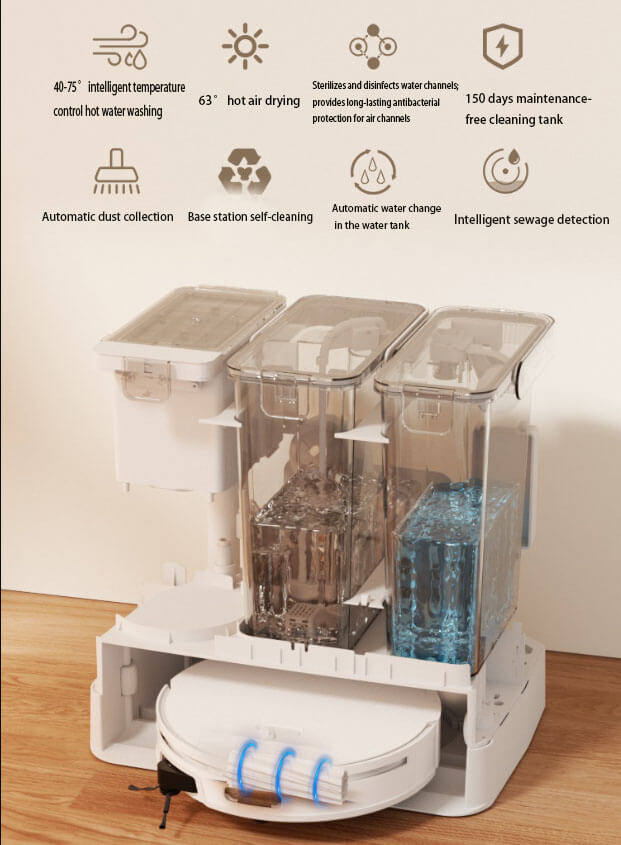
Conclusion: The Reversed Procurement Paradigm
The most successful B2B buyers of robot vacuums will be those who reject the consumer narrative. They will instead adopt a reversed, outcome-oriented paradigm: start with the specific operational pain point (e.g., daily lobby maintenance, warehouse dust control), define the required hybrid cleaning system , and then work backward to select a technology partner based on TCO, certification, and support infrastructure—not just suction power or brand name. In a market accelerating toward $17 billion, this disciplined, reverse-engineered approach is the only way to secure a truly value Super high commercial cleaning solution .